On this page
So Can Dogs Eat Mushrooms, or Not?
Yes, dogs can eat many plain culinary mushrooms safely, and some may even interact with the gut microbiome itself. That’s the short answer I give owners in exam rooms, and it’s true as far as it goes — but it skips the part that actually matters clinically, which is that “mushroom” covers thousands of species with wildly different chemistry, and only a tiny slice of them ever end up in a dog’s bowl on purpose.
I’ve had this exact conversation more times than I can count. A client brings in a twelve-year-old Cavalier who nosed a sliced white button mushroom off the cutting board, and in the same week I get a call about a young Lab who ate something gray and gilled out of the mulch bed during a Sunday-morning yard patrol. Both dogs “ate a mushroom.” Only one of those is a phone call I take seriously.
Which Grocery-Store Mushrooms Are Actually Fine?
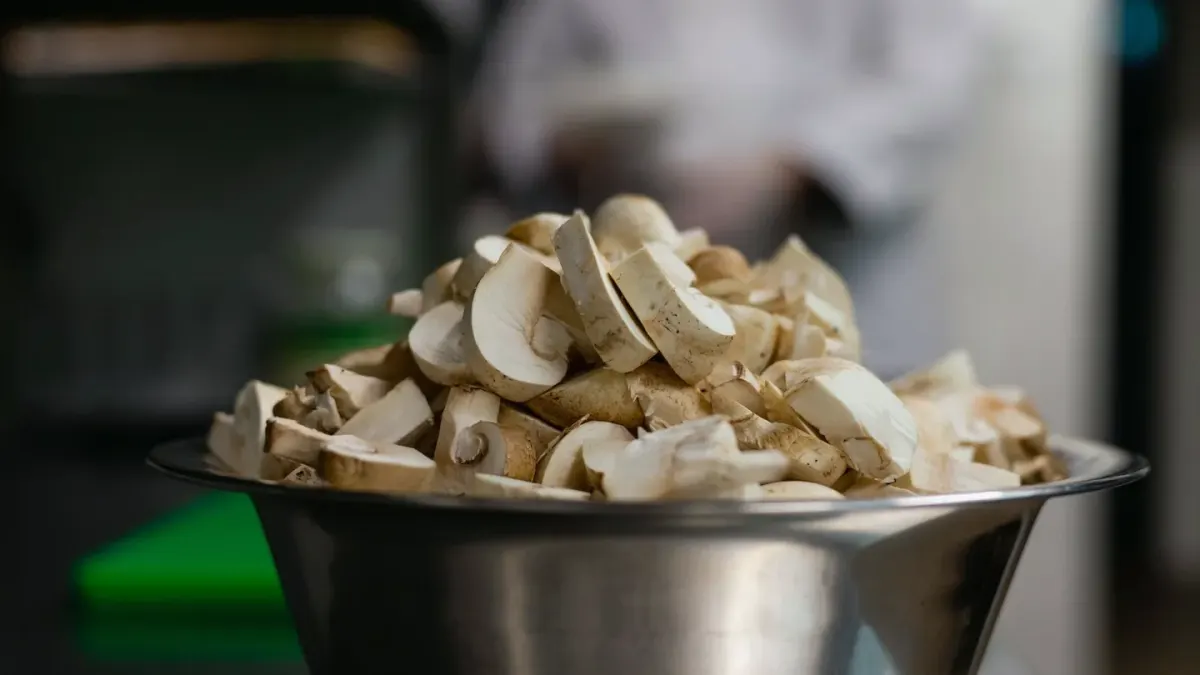
Plain button, cremini, portobello, shiitake, and oyster mushrooms — cooked, unseasoned, no garlic, onion, or heavy butter — are generally fine for dogs in small amounts as an occasional addition, not a diet staple. Skip raw mushrooms if you can; cooking breaks down some of the tougher chitin-based cell walls, which tends to make them easier on digestion, and it eliminates any doubt about whether a stray wild cap got mixed into a batch you didn’t grow yourself.
I’d rather a dog get fiber and moisture from something with a longer track record — pumpkin is the one I reach for most often in practice, because pumpkin fiber is a gentle, natural source of both soluble and insoluble fiber, per the veterinary consensus I rely on for routine digestive cases. Mushrooms aren’t in that same well-mapped category yet, which is the honest caveat worth sitting with before you make them a habit.
What About the Beta-Glucans I Keep Hearing About?
This is where the marketing outruns the microbiome research, and it’s worth slowing down. Culinary and “medicinal” mushrooms — turkey tail, reishi, lion’s mane, maitake — contain beta-glucan polysaccharides that bind pattern-recognition receptors on immune cells, which is a real and well-described mechanism, not a fabricated one. The strongest single data point in dogs comes from a small University of Pennsylvania trial: fifteen dogs with hemangiosarcoma were split across three doses of a Coriolus versicolor (turkey tail) extract, and the highest dose group had a median survival of roughly 199 days, according to Penn Today. That is a genuinely interesting signal from a genuinely small trial — fifteen dogs, one cancer type, one extract, no placebo arm reported alongside it in that coverage. I wouldn’t extrapolate it to “mushrooms fight cancer” any more than I’d extrapolate a single case to a population.
The gut-microbiome angle is thinner still. Beta-glucans are technically fermentable fiber, so it’s reasonable to assume they feed some resident bacteria the way other prebiotic fibers do — see our Complete Guide to Dog Gut Health and Digestion for how that fermentation process generally works. But “reasonable to assume” isn’t the same as “demonstrated.” Even in probiotic research, where the study designs are more mature, a 2025 randomized trial published in Frontiers in Veterinary Science found that diversity metrics did not distinguish non-responders from responders — meaning the microbiome readouts researchers usually reach for didn’t reliably predict which dogs actually improved. If that’s still true for dedicated probiotic strains studied directly, I’m not going to claim more certainty for mushroom beta-glucans, which have far less canine-specific trial work behind them.

Is a Wild Mushroom in the Yard Really an Emergency?
Yes — and this is the one place I don’t hedge. The most dangerous species in North America, Amanita phalloides (the death cap) and its relatives, can cause liver failure that doesn’t show obvious symptoms for six to twelve hours, by which point real damage is already underway. ASPCA guidance is blunt about this: a delay in treatment can be dangerous with some mushroom species, and pet parents should call a poison control line rather than wait to see what happens. UC Davis School of Veterinary Medicine notes that most wild mushrooms a dog encounters are actually non-toxic, but the ones that aren’t can cause severe GI upset, seizures, and organ damage — and there’s no reliable way to eyeball the difference in a backyard or on a trail.
My rule with clients is simple and I don’t soften it: if you can’t positively identify a mushroom your dog just ate down to species, treat it as an emergency and call ahead to the clinic or a poison control line, even if the dog seems fine. Fine at minute ten doesn’t rule out liver injury at hour ten.
How Do I Decide What’s Worth Feeding?
Here’s where I land, and I’ll name the counterargument first because it’s a fair one: some owners point to the Penn hemangiosarcoma data and the broader beta-glucan literature and argue that if the mechanism is real and a small trial showed a survival signal, waiting for more canine-specific dosing studies just costs a sick dog time it doesn’t have. I understand that instinct, and in a genuinely terminal diagnosis, I’ve talked owners through using a mushroom extract as one piece of a broader plan, alongside — never instead of — the treatment their oncologist recommends.
But for the healthy dog snacking on plain mushrooms at dinner, or the owner deciding whether to add a mushroom powder to a bowl of food, the calculus is different, and I hold a firmer line there. A balanced gut microbiome supports overall immune function in general terms, which is the direction the research points, but that’s not the same as evidence that a specific mushroom powder measurably shifts a healthy dog’s microbiome or its resilience. I’d rather owners spend their supplement budget and their vet’s attention on categories with denser dog-specific trial data — our piece on what a healthy dog gut microbiome actually looks like is a reasonable starting point for calibrating expectations — and treat culinary mushrooms as an occasional, plain-cooked add-in rather than a functional ingredient doing measurable work.
The dog I keep coming back to is a nine-year-old mixed-breed whose owner had started sprinkling a reishi powder into dinner every night after reading about immune support online, hoping it would help with some low-grade skin flare-ups that came and went with the seasons. Nothing about that plan was reckless — the dose was modest, the dog tolerated it fine, and there was no harm being done. What I pushed back on gently was the expectation attached to it: she’d started treating the powder as the fix, instead of working through the actual allergy workup with her regular vet. We kept the mushroom powder, because it wasn’t hurting anything, but we didn’t let it substitute for diagnostics. That’s usually the more useful conversation than “is it safe” — it almost always is, in small amounts; the real question is what you’re expecting it to do instead of something else.
Frequently asked questions
Can dogs eat raw mushrooms?
It's better to cook plain culinary mushrooms first — cooking softens the chitin in the cell walls and makes them easier to digest, and it removes any question of whether a foraged cap got mixed in with a store-bought batch.
What's the most dangerous mushroom for dogs?
Amanita phalloides, the death cap, is the most concerning species in North America because it can cause liver failure with symptoms that may not appear for six to twelve hours after ingestion, according to the ASPCA.
Do mushroom supplements actually help a dog's gut microbiome?
The mechanism — beta-glucans acting as fermentable fiber and immune-receptor ligands — is real, but dog-specific trial data on microbiome outcomes is thin. Treat mushroom supplements as an unproven adjunct, not a demonstrated gut-health fix.
Sources
- Not-So-Magic-Mushrooms: Tips to Keep Your Pets Safe — ASPCA
- Mushroom Toxicity in Dogs — UC Davis School of Veterinary Medicine
- Compound Derived From a Mushroom Lengthens Survival Time in Dogs With Cancer, Penn Vet Study Finds — Penn Today
- Probiotic Response and Microbiome Diversity in Dogs — Frontiers in Veterinary Science