
On this page
Fenway, an 8-year-old bulldog mix who comes into my clinic for weight and joint management, got half a banana as a training reward most afternoons for about three weeks before his owner mentioned, almost in passing, that his stool had gone soft. Sixty-two pounds, food-motivated, otherwise stable — nothing about the case looked alarming on paper. But it’s a pattern I’ve watched often enough to trust: banana in, loose stool eventually out, for a subset of dogs and not for others. That inconsistency is the actual story here, more than whether the fruit is “safe.”
The Nutrient Math, Not the Marketing Copy
A medium banana runs about 110 calories, roughly 28 grams of carbohydrate, 15 grams of that as natural sugar, 3 grams of fiber, and 450 mg of potassium. That ratio — five parts sugar to one part fiber — is the whole clinical picture in miniature. Dogs tolerate small amounts of fructose reasonably well. What they don’t get a pass on is volume, and a “quarter of a banana” fed daily adds up faster than most feeding charts imply.
The American Kennel Club frames portion size around body weight rather than a flat serving: dogs under 20 pounds should stay to one or two quarter-inch slices, while dogs over 90 pounds might tolerate up to half a banana. The peel is a separate issue entirely — not toxic, but fibrous enough to risk an obstruction, which is why I don’t feed it and don’t recommend clients do either.
Green Versus Ripe: Where the Resistant Starch Actually Lives
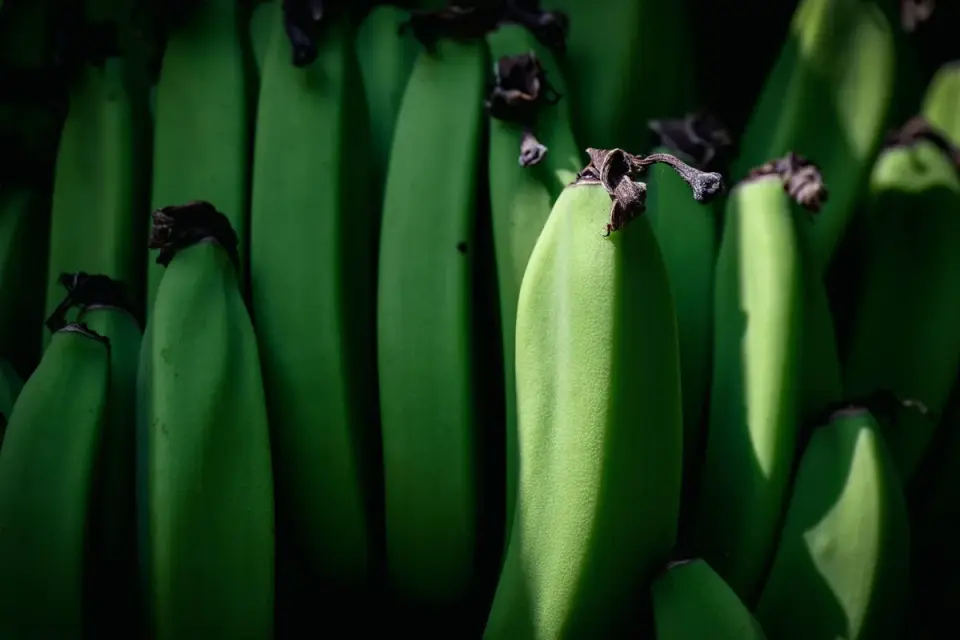
This is the part most owners skip past, and it’s the part I find genuinely interesting as a nutritionist. Unripe, green banana contains meaningfully more resistant starch than the yellow, spotted fruit most people reach for. Resistant starch survives digestion in the small intestine and reaches the colon largely intact, where it becomes fuel for fermentation rather than a quick glucose spike.
A mouse study published on PMC found that green banana flour helped restore gut microbiota diversity and intestinal barrier integrity after antibiotic disruption, with enrichment of several beneficial bacterial families during recovery. That’s a rodent model, not a canine clinical trial, and I want to be direct about that boundary: it tells us resistant starch has a plausible fermentation pathway worth taking seriously, not that a ripe banana in a dog’s bowl replicates the effect. Ripe banana has converted much of that resistant starch to simple sugar during ripening, which is exactly why the fruit most dogs actually eat is closer to a sugar treat than a fiber supplement.
Where the Fiber Story Gets Complicated
Not every gut handles fermentable fiber the same way, and this is where I ask clients to slow down rather than assume “natural” means “gentle for every dog.” In dogs with exocrine pancreatic insufficiency, digestive management already runs on a tighter script. As one review in JAVMA puts it, “EPI is treated by pancreatic enzyme replacement therapy, nutritional management (low-residue diets with moderate fat content), and supplementation of cobalamin.” A low-residue diet and an occasional dose of fermentable banana fiber are pulling in different directions, so I don’t add banana as a routine extra for those patients without checking in first.
Even outside EPI cases, individual variability in fiber response is real and not fully explained by current research. A recent trial noted in Frontiers in Veterinary Science found that “diversity metrics did not distinguish non-responders from responders” — meaning a dog’s baseline microbial diversity doesn’t reliably predict who benefits from a given fiber or probiotic intervention. That’s an honest gap in the evidence, and I’d rather say so than imply we can predict Fenway’s outcome from a stool sample alone. If you want the fuller picture of how microbial diversity and fermentation connect to day-to-day digestion, our guide to dog gut health and digestion walks through the mechanism in more depth.
Also worth noting: the same review flags that persistent dysbiosis often continues in EPI patients even after enzyme therapy starts, and “future studies are needed to further understand the causes of persistent dysbiosis in animals with EPI following initiation of pancreatic enzyme replacement therapy and assess the efficacy of treatments to ameliorate these abnormalities.” Fiber additions in that population are genuinely uncharted territory, not a settled recommendation either way.
I saw a version of this play out with a 4-year-old Labrador retriever, recovering from a pancreatitis flare, whose owner wanted a “natural” swap for the bland-diet toppers she’d been using during recovery. She’d read that banana was a gentle fruit and started adding a tablespoon of mashed banana to the prescription food. Within a week the dog’s stool went from formed to soft, and it wasn’t obvious at first whether that was the fiber, the sugar load, or simple diet inconsistency during a recovery period that called for less variability, not more. We pulled the banana, stool firmed back up within days, and that was the end of the experiment. One case doesn’t prove banana caused it — but it’s exactly the kind of variable I ask owners to control for when a dog’s gut is already under stress.
The Portion Math I Actually Recommend
For a healthy adult dog with no digestive history, a thin slice or two, a few times a week, sits comfortably inside a reasonable treat allowance. For dogs managing weight, diabetes risk, or any diagnosed digestive condition, I treat banana the same way I’d treat any calorie-dense, sugar-forward snack: occasional, small, and not a daily habit. Freezing slices can slow down an eager eater and turn the treat into more of a occupation than a quick bite, which matters more for behavior than for nutrition, but it’s a trick worth knowing.

My Verdict, Stated Plainly
Banana isn’t a supplement, and it isn’t a hazard. For most healthy dogs, a small portion is a defensible, low-cost treat with a real nutrient profile behind it — potassium, a touch of fiber, some B6. Where I diverge from the “just a harmless snack” framing you’ll see elsewhere is in treating the sugar load and the fiber fermentation as two separate clinical variables, not one. A dog managing EPI, pancreatitis history, or unexplained loose stool deserves a more cautious default than a dog with a boring, stable gut. If you’re building out a broader sense of what a resilient microbiome actually looks like day to day, our piece on what a healthy dog gut microbiome looks like is the natural next stop — it covers the baseline you’re comparing any treat experiment against.
Practical next step: if you want to try banana, start with one thin slice, watch stool consistency over the next 24 to 48 hours, and don’t stack it with other new fiber sources in the same week. That’s how you’ll actually learn what your dog’s gut does with it, rather than guessing from a feeding chart.
Frequently asked questions
Can dogs eat banana peels?
No — the peel isn't toxic, but it's fibrous and hard to digest, and it's better removed before feeding to avoid a possible blockage risk.
Is banana better than pumpkin for a dog's digestion?
They're not interchangeable. Banana leans toward fast sugar with a small fiber contribution, while unripe or green banana carries more resistant starch; the right choice depends on whether you're managing sugar intake or looking for fermentable fiber.
Sources
- Can Dogs Eat Bananas? Can Dogs Have Bananas? — American Kennel Club
- Green Banana Flour Contributes to Gut Microbiota Recovery and Improves Colonic Barrier Integrity in Mice Following Antibiotic Perturbation — PMC
- Exocrine Pancreatic Insufficiency: Treatment and Dysbiosis Review — JAVMA
- Probiotic Response and Microbial Diversity in Dogs — Frontiers in Veterinary Science