On this page
Waffles is a 22-pound Boston Terrier who comes in every twelve weeks for an idiopathic epilepsy recheck, phenobarbital level drawn, weight logged, gait watched. Three visits ago his owner asked me, almost as an afterthought while I was palpating his abdomen, whether strawberries were an okay reward for pill time — he’d put on three pounds since starting therapy and she wanted something low-calorie that wasn’t just kibble. It’s a small question, but it’s the one I get more than almost any other diet question in my exam room, and it deserves a real answer instead of a reflexive “sure, in moderation.”
The short version: yes, strawberries are non-toxic to dogs, and for most healthy adults a few thin slices are a reasonable treat. But “can” and “should, how much, and for which dog” are three different questions, and the gut-health angle — fiber, sugar, and what a strawberry actually does once it’s fermenting in the colon — is where most owner-facing advice stops short.
What’s Actually in a Strawberry, From a Gut’s-Eye View
A strawberry is mostly water, but the solid fraction is where the interesting biology lives. According to AKC, strawberries are non-toxic, low in calories, and provide fiber, antioxidants, and vitamin C — the trio most owners have already heard about. What gets less airtime is the mechanism: fiber isn’t inert bulk. It’s substrate. The soluble fraction of a strawberry’s fiber reaches the colon largely intact and becomes fuel for resident bacteria, which ferment it into short-chain fatty acids that feed the colon lining itself.
That’s not unique to strawberries — it’s the same basic pathway researchers have documented for other fiber-bound produce fed to dogs. A study on fiber-bound polyphenol ingredients published in PMC found that feeding these ingredients at different levels modulated colonic postbiotic output and improved measures of gut health in dogs, with the polyphenol and fiber components working together rather than as separate additives. Strawberries carry both fiber and polyphenolic antioxidants in the same bite, which is part of why they’re grouped with blueberries and other berries when nutritionists talk about fruit as a minor prebiotic contributor rather than a therapeutic one.
The Sugar Question My Overweight and Diabetic Patients Force Me to Answer
Here’s where I get more conservative than a lot of the blanket “strawberries are a healthy treat” advice out there. A strawberry is roughly 5 grams of sugar per 100 grams, most of it fructose and glucose rather than starch, and for a healthy 30-pound dog that’s genuinely trivial. For a dog managing diabetes mellitus or carrying extra weight, it isn’t automatically trivial, because the treat doesn’t exist in isolation — it’s added on top of a calorie and glucose budget that’s already been tuned.
I don’t tell owners of stable diabetic dogs to avoid strawberries outright. I tell them to treat the fruit the way I’d treat any variable in a case I’m trying to keep predictable: same size, same time relative to insulin and meals, logged consistently, not offered as a random reward whenever the dog does something cute. That’s a clinical-management answer, not a nutrition-label answer, and it’s the distinction that gets lost when advice gets compressed into a single yes-or-no.

Where the Fiber Evidence Is Genuinely Encouraging — and Where It’s Thin
I want to be honest about the strength of the microbiome research here, because this is a lab that’s supposed to grade the evidence, not just repeat it. A supplement study evaluating a prebiotic and postbiotic blend in healthy dogs, published in Veterinary Sciences, looked at gut microbiota, intestinal barrier markers, and inflammation — the kind of mechanistic, structure/function outcome that’s genuinely useful for understanding how fermentable fiber behaves in a dog’s gut. That’s the strong end of the evidence: we have a reasonably clear picture of the fermentation pathway and what short-chain fatty acids do for colonocyte health.
What’s thinner is any dog-specific research on strawberries themselves, as opposed to fiber and polyphenols in general. And even within probiotic and prebiotic research broadly, the field admits its own limits. A 2025 study in Frontiers in Veterinary Science evaluating probiotic response in dogs found that diversity metrics did not distinguish non-responders from responders — meaning a “healthier-looking” microbiome on paper didn’t reliably predict which dogs actually improved clinically. That finding should make anyone cautious about overselling what fruit-based fiber, or any prebiotic input, definitively does for an individual dog’s gut. Readers looking for the broader mechanism can start with our guide to dog gut health and digestion or the baseline picture of what a healthy gut microbiome looks like before layering fruit-specific claims on top.
I’ll admit the counterargument here, because it’s a fair one: some owners and even some colleagues argue that if the effect size of a few strawberry slices is that small, why complicate a simple treat with caveats about diversity metrics and responder status? My answer is that the complication isn’t about the strawberry — it’s about the dog eating it. A healthy Labrador and a diabetic Miniature Schnauzer are not the same decision, even if the fruit in front of them is identical.
I had a 10-year-old Miniature Schnauzer in for a glucose curve a while back — 14 pounds, diagnosed with diabetes mellitus eight months earlier, generally well regulated on twice-daily insulin. Her owner had been giving her the tops and stray pieces of strawberries all summer, not measured, just whatever fell off the cutting board. The curve that day was noisier than her last one, and while I can’t say the strawberries alone explained it, the timing lined up closely enough that we tightened the protocol: two thin slices, always with breakfast, never as a random afternoon snack. Her next curve was cleaner. That’s one case, not a study, but it’s the kind of pattern that makes me reach for both the imaging study and the acupuncture needle in my own specialty — respect what the aggregate data shows, and still look hard at the animal actually in front of you.

How I Actually Recommend Feeding Strawberries
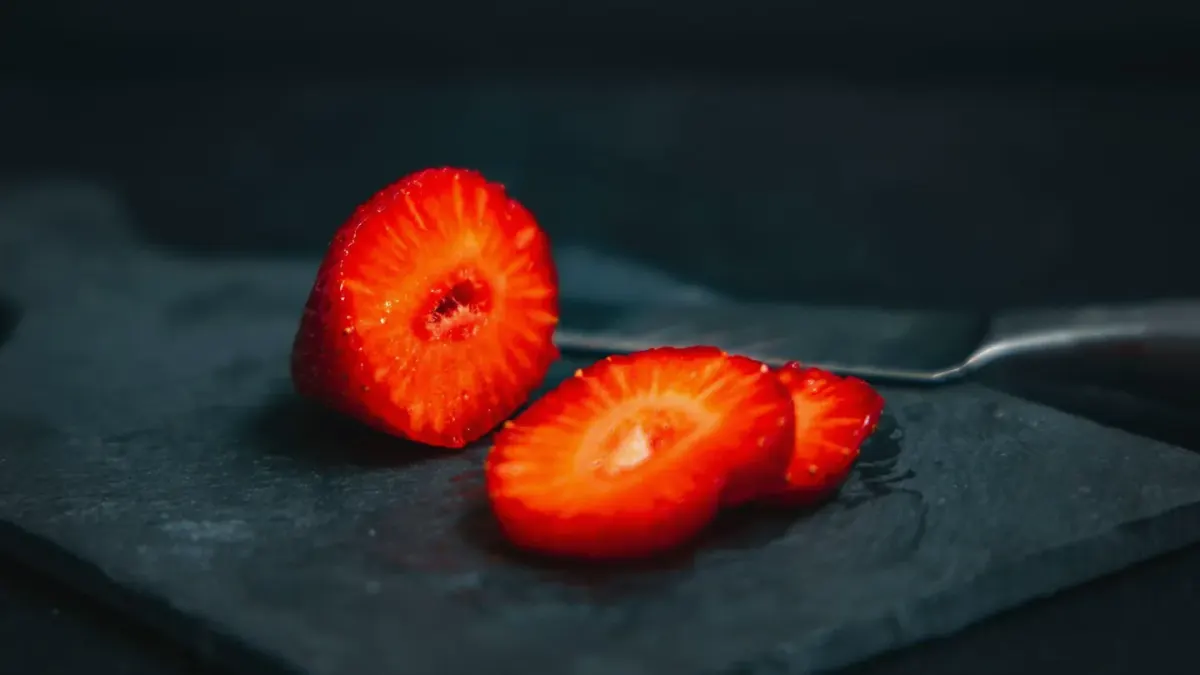
Wash the berries, remove the leaves and stem, and cut them into pieces sized for the dog in front of you — quarter-inch slices for a small dog, larger for a big one, always small enough that swallowing whole isn’t tempting. Skip anything sweetened, candied, or turned into jam, syrup, or baked goods; those routinely carry refined sugar or xylitol, and xylitol is a genuine emergency regardless of how small the strawberry component is. Keep the total treat load, strawberries included, to a small fraction of the day’s calories, and introduce them gradually the first time so you can watch stool and appetite rather than assuming tolerance.
For dogs with a known sensitive gut — a history of pancreatitis, exocrine pancreatic insufficiency, or chronic soft stool — I’m more cautious with any new fiber source, strawberries included, until the underlying condition is stable. Dogs with exocrine pancreatic insufficiency are managed with pancreatic enzyme replacement therapy, a low-residue diet with moderate fat, and cobalamin supplementation, according to a review in the Journal of the American Veterinary Medical Association, and that same review notes that persistent dysbiosis can linger even after enzyme therapy starts — which tells me a novel fiber source is not the first thing I’d add to that dog’s bowl.
The Bottom Line for Most Dogs
For the healthy, stable majority of dogs, a few strawberry slices are a low-stakes, occasionally useful treat — some fiber, a little vitamin C, a lot of water, and not much metabolic cost. For the dog managing diabetes, obesity, or a GI condition that’s still being worked up, the fruit itself is rarely the risk; the lack of a plan around it is. I’d rather a client bring me a specific question — how many slices, how often, alongside which medication schedule — than assume the internet’s blanket “yes, in moderation” covers their particular dog. It usually does. Sometimes it doesn’t, and that’s worth finding out before the treat becomes a habit.
Frequently asked questions
How many strawberries can a dog eat?
For most healthy adult dogs, one to a few thin slices a few times a week is a reasonable ceiling, kept within a small share of the day's total calories. Smaller dogs need proportionally smaller portions than larger dogs.
Can dogs eat strawberry leaves or the green top?
No. The leaves and stem aren't toxic in the way some plant material is, but they're difficult to digest and can upset the stomach, so it's best to hull the berry before offering it.
Are strawberries safe for dogs with diabetes?
Talk to your veterinarian first. Fresh, unsweetened strawberries in small, consistent portions are tolerated by some stable diabetic dogs, but the timing relative to insulin and meals matters more than the fruit itself.
Can puppies eat strawberries?
In small amounts once they're eating solid food, yes, but introduce any new food gradually and watch for loose stool, since a puppy's gut is still developing.
Sources
- Can Dogs Eat Strawberries? — AKC
- Effects of a Novel Prebiotic and Postbiotic Dietary Supplement on Gut Microbiota, Intestinal Barrier Markers, and Inflammation in Healthy Dogs — Veterinary Sciences
- Feeding Fiber-Bound Polyphenol Ingredients at Different Levels Modulates Colonic Postbiotics to Improve Gut Health in Dogs — PMC
- Exocrine Pancreatic Insufficiency: Treatment and Persistent Dysbiosis in Dogs — Journal of the American Veterinary Medical Association
- Probiotic Response and Microbiome Diversity in Dogs — Frontiers in Veterinary Science