
On this page
I still remember a nine-year-old Labrador named Gus who came into my referral practice because his owner thought he was “just getting old and slow.” Over about six weeks, he’d gone from bounding up the porch steps to hesitating at the bottom of them. He wasn’t limping, and he wasn’t crying out when I flexed his hips. What he was doing was scuffing the tops of his back paws on the tile floor of the exam room, just barely, in a way his owner had chalked up to clumsiness. That scuffing is what moved this from “arthritis” to “let’s do a neurologic exam” in my head before I’d even touched him.
Start here. Before you read another paragraph, run through this list with your dog in the room:
- Is there pain? Yelping, guarding a hip, or reluctance to be touched points toward joints, not nerves.
- Are the toenails or paw tops scuffed or worn down? Dragging suggests the limb isn’t being placed correctly — a nerve-pathway problem.
- Did it come on over hours (or overnight), or over months? Sudden onset raises the odds of a spinal emergency; slow decline over months is more consistent with degenerative disease or chronic joint wear.
- Is one side worse, or both equally? Symmetric weakness in an older, large-breed dog is a hallmark of degenerative myelopathy; one-sided pain is more typical of a disc or orthopedic problem.
- Can your dog still feel a gentle pinch between the toes? Loss of deep pain sensation is a genuine emergency, not a “wait and see” situation.
I’ll expand on each of those below, but the short version is this: hind leg weakness isn’t one condition, it’s a symptom with at least three very different pathways behind it, and the exam findings — not the wobble itself — tell you which one you’re dealing with.
Joint Pain or Nerve Pathway? The Split That Matters Most
Every case of hind leg weakness I see eventually sorts into one of two buckets: orthopedic (hips, knees, spine acting as a mechanical structure) or neurologic (the nerve pathways that carry signals from the brain to the hind limbs and back). They can look similar from across the room and behave completely differently up close.
Hip dysplasia and osteoarthritis are painful conditions. Dogs with these problems are often stiff after rest, warm up into a better gait, and resist having a hip extended. According to Hip Dysplasia in Dogs, published by VCA Animal Hospitals, dysplastic hips cause progressive joint laxity and secondary arthritis that shows up as reluctance to jump, bunny-hopping gaits, and muscle loss over the hindquarters.
Degenerative myelopathy, by contrast, is a non-painful, progressive spinal cord disease. Per the Riney Canine Health Center’s writeup on degenerative myelopathy from Cornell University College of Veterinary Medicine, affected dogs — typically eight years or older — first lose coordination in the hind limbs, then develop weakness, then paw-knuckling and dragging, with no evidence of pain on exam. That absence of pain, paired with scuffed nails, is the single clue I lean on hardest in a first visit.
The two conditions can and do coexist in the same dog, which is exactly why “he’s just old” is a diagnosis I try to talk owners out of using.
When It Comes On Fast: Disc Disease and Spinal Emergencies
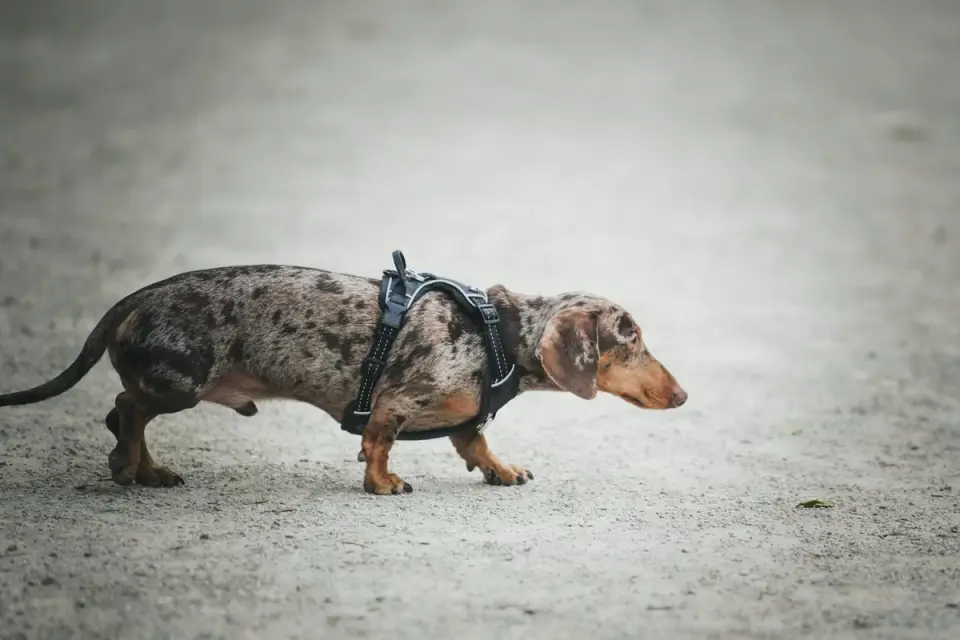
If weakness develops over hours to a couple of days, the calculus changes. Intervertebral disc disease — a disc bulging or rupturing and compressing the spinal cord — is, per Intervertebral Disk Disease in Dogs (IVDD) in Dogs from PetMD, capable of producing signs that range from back pain alone to dragging, knuckling, and progression to complete hind-limb paralysis as compression worsens. This is not a condition where a few days of rest and see-how-it-goes is a neutral choice; deep pain sensation can be lost, and the window to intervene surgically narrows the longer compression continues.
I want to be direct about where my own expertise applies and where it doesn’t: I can tell you, as a neurologist, that acute-onset hind leg weakness with any suspicion of spinal pain warrants same-day veterinary evaluation, full stop. I can’t tell you what any specific supplement, diet, or home remedy will do for a compressed spinal cord, because that’s not a question the mechanism supports an answer to — and I’d rather say that plainly than let a worried owner wait on something that isn’t built for the job at hand.
The Slow-Onset Cases: What I Actually Watch For
One of the dogs I’ve followed longest was a 62-pound German Shepherd named Bodie, age eight and a half, whose owner first noticed him swaying slightly when he stood still in the kitchen — not falling, just a faint side-to-side sway she described as “like he was on a boat.” Over four months that progressed to scuffing his rear nails on the driveway, then to genuine trouble climbing the two steps into her SUV. He wasn’t in pain at any point; he still wagged his tail and ate normally, and orthopedic films of his hips came back unremarkable. That combination — no pain, symmetric decline, normal orthopedic imaging, older large-breed dog — is the exact pattern that pushes degenerative myelopathy to the top of a differential list, though a genetic test and ruling out compressive disease are still part of confirming it rather than guessing from gait alone.
Where Body Condition and General Health Fit In
Muscle wasting changes how any of these conditions present, and a dog that’s carrying extra weight or losing lean muscle from inactivity will look weaker than the underlying joint or nerve problem alone would predict. This is where general conditioning — not a specific fix for either disease — genuinely matters: a leaner dog with better core and hind-limb muscle mass tolerates both arthritis and early neurologic decline better than a deconditioned one. If you’re working on your dog’s overall condition alongside a mobility workup, our guides on The Complete Guide to Dog Gut Health and Digestion and What a Healthy Dog Gut Microbiome Looks Like cover the digestive and microbiome side of that broader condition picture, which is a separate question from what’s causing the leg weakness itself.
What I Tell Owners in the Exam Room
By the time Gus’s workup was done, imaging had ruled out a compressive disc lesion, and his pattern — painless, symmetric, slowly progressive, in a breed with known risk — was consistent with degenerative myelopathy. His owner asked me, reasonably, whether a supplement or diet change could turn things around. I told her the honest answer: supporting a dog’s general muscular and neurologic function through conditioning, weight management, and physical therapy is a real and worthwhile thing to do, and it is not the same as reversing a degenerative spinal cord disease. Separating those two ideas — supporting normal function versus treating a diagnosed neurologic disease — is the single most useful distinction I make with every owner in this position, because conflating them leads either to false hope or to skipping the physical therapy and mobility support that can genuinely help a dog cope day to day.
Bottom Line
If your dog’s hind legs are weakening, the single most useful thing you can do is separate “painful” from “painless” and “sudden” from “gradual” before you decide how urgently to act — because those two axes, more than the weakness itself, are what point a veterinary exam toward joints, a disc, or a slow-progressing nerve pathway disease.
Frequently asked questions
Is hind leg weakness in dogs always an emergency?
No. Sudden weakness with suspected back pain deserves a same-day vet visit, but slow, painless decline over weeks to months — as seen with degenerative myelopathy — is worked up urgently but isn't a middle-of-the-night crisis unless deep pain sensation is lost.
Can arthritis and a neurologic disease cause hind leg weakness at the same time?
Yes, and it's common in older large-breed dogs, which is exactly why an exam that checks both joints and reflexes matters more than guessing from the gait alone.
Does a supplement or diet change fix degenerative myelopathy?
No. Supporting general muscular and neurologic function through conditioning and physical therapy is worthwhile, but it isn't the same as reversing a degenerative spinal cord disease, and no supplement should be framed as doing so.
What's the one physical exam sign that worries a neurologist most?
Loss of deep pain sensation — the response to a firm pinch between the toes. That finding changes the urgency of the entire situation.
Sources
- Hip Dysplasia in Dogs — VCA Animal Hospitals
- Degenerative myelopathy — Cornell University College of Veterinary Medicine
- Intervertebral Disk Disease in Dogs (IVDD) in Dogs — PetMD