
On this page
To protect working joints through a demanding training block, manage load first and use joint support to back normal cartilage function. That is the order I defend for sport, herding, detection, and hunt dogs entering heavier work, because no powder rewrites too many hard repetitions on tired tissue.
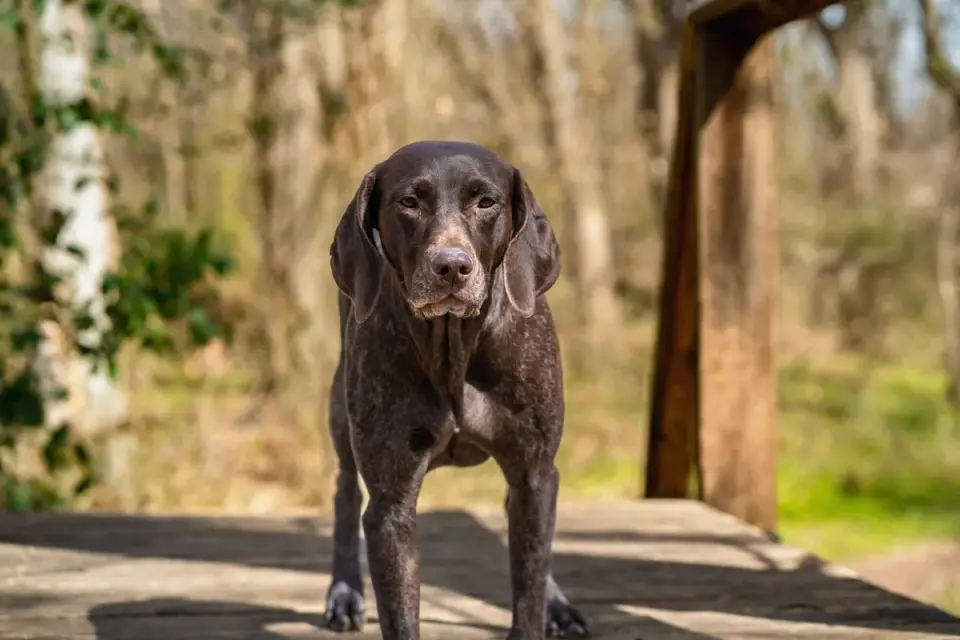
Three weeks into preseason, a 4-year-old 62-pound German Shorthaired Pointer started cutting corners wide on blind retrieves and sitting slowly after truck rides. Her handler was adding morning roading plus evening marks, six days straight, on hard-packed dirt with no deload day. The worry was early arthritis, and the choice being weighed was whether to add a joint chew or pull back running mileage. By day 10 of a revised plan with alternate-day running, warm-up walks, and a rest day, her sit speed looked normal again and the wide turns had shortened. That pattern — workload spike, subtle stiffness, quick response to load control — is what I watch for before I talk ingredients.
Training load hits joints before you see it
Working dogs do not wear cartilage evenly. Sprint, jump, tight turn, and sudden stop concentrate force through shoulders, elbows, hips, and carpus, while repetitive impact dries out the normal cushioning rhythm of the joint. Synovial fluid bathes cartilage and helps distribute load, and conditioning, body weight, surface, and sleep all change how well that system keeps up.
Load is the lever.
You can support that system, but you cannot out-supplement a schedule with no recovery. I keep training logs more like medical charts during a demanding stretch: minutes worked, surface type, intensity, body condition, and next-morning stiffness on a 0-to-3 scale. If stiffness lasts more than an hour after warm-up or the dog shortens stride two days in a row, volume drops first. For background on how cartilage-targeted ingredients differ, handlers often compare notes in Type II Collagen vs. Type I Collagen for Dog Joints: Which One Actually Matters? and Collagen vs Glucosamine for Aging Dog Joints.
What the studied actives may support, in plain language
This is where I stay narrow. Glucosamine and chondroitin are widely used for joint support, and the lab work gives us mechanisms to discuss without promising a performance outcome.
Chondroitin has been described in work reported in Frontiers in Veterinary Science with the structure/function phrase “supports healthy synovial fluid homeostasis.” That matters for a working dog because fluid balance is part of how joints handle normal daily loading. Evidence here is peer-reviewed but still early for field performance, so I call it plausible support for normal joint lubrication, not proof of faster times or fewer injuries.
Glucosamine HCl has laboratory data described in the Journal of Veterinary Medical Science as work that “prevent experimentally induced cartilage degradation in vitro.” In vitro means in cells or tissue in a dish, not in a running Labrador. I translate that for handlers this way: it is a reason to consider glucosamine as background support for normal cartilage structure during a season, not a reason to extend a session.
Green-lipped mussel brings omega-3s and glycosaminoglycans that have been studied for joint support. In a rodent model summarized in Nutrients, researchers found “BMO, GMO, and KO all alleviated paw swelling in rats and reduced serum levels of rheumatoid factor (RF), anti-cyclic citrullinated peptide (anti-CCP) antibody, and pro-inflammatory cytokines such as TNF-α and IL-17.” That is animal-model inflammation biology, not a working-dog trial, and I grade it as thin-to-mixed for direct transfer. Handlers comparing marine oils can see how the lab weighs that evidence in Green-Lipped Mussel vs Fish Oil for Dog Joints: What the Lab Data Actually Shows.
A 6-year-old 84-pound Labrador Retriever in hunt-test prep shows the tradeoff. His owner added a double dose of two joint products after a weekend of back-to-back water marks, hoping to push through a stiff Monday, while keeping daily retrieves at full volume. For three weeks the dog looked okay warming up, then started bunny-hopping on stairs and refusing the truck jump by day 21. The vet found no acute tear, just overload plus excess supplementation with GI upset and no conditioning adjustment. Cutting volume, adding leash walks and physiotherapy exercises, and returning to a single label-directed routine steadied him. More in the bowl did not fix more on the field.
The handler’s week that actually protects joints
Translate mechanism into tomorrow: protect fluid movement and cartilage with routine, not rescue doses. I use a simple template for fit adult working dogs already cleared by their vet.
Warm up 10 minutes on leash with trots and turns before hard work, then cool down the same way. Rotate surfaces across the week — grass, sand, shallow water, and one harder day — rather than pounding the same dirt road daily. Hold one full rest day, keep nails short, keep ribs easily felt but not seen, and track morning sit-to-stand speed as your early signal. Strength work twice weekly with hills, cavaletti poles, and controlled sits helps muscles absorb force so joints do less braking.
Nutrition stays boring on purpose. Feed to maintain lean condition, hydrate before and after, and if you use glucosamine, chondroitin, or green-lipped mussel, pick one complete formula, follow label directions, and give it 4–6 weeks to assess tolerance alongside training changes. Do not stack multiples to chase faster results.
A 2-year-old 48-pound Border Collie in agility shows the edge case. She was sound, lean, and lightly worked, but her owner wanted year-round joint chews because a sibling had elbow dysplasia. Radiographs at 18 months were actually borderline, and growth plates had only recently closed. Here the plan flipped: the priority was not training volume but growth history, genetics, and vet imaging, with low-impact conditioning, jump-height restraint, and joint nutrition discussed as long-term support for normal function rather than season armor. For young dogs with similar questions, growth and calcium balance matter more than most handlers expect, as reviewed in Human Calcium Supplement Pills and a Growing Puppy’s Joints.
Why I still start with load, not the scoop
The strongest counterargument is fair: if an ingredient supports normal cartilage or fluid balance, why not lead with it and keep training hard? Because in working dogs the dose-response for injury comes from repetition, fatigue, and surface, and no in vitro or rodent finding has shown it can offset that math. I would rather see a handler cut 20% of jumps, add sleep, and use one studied formula consistently than keep volume and double supplements.
So my position holds: condition first, surface and rest second, steady basic joint support third, vet exam promptly for persistent lameness, swelling, or behavior change. The microbiome angle fits here too — gut health shapes overall resilience and nutrient handling — but I will not claim probiotics protect knees. The data do not say that yet.
What would change in your log this week if joints, not speed, set the schedule?
Frequently asked questions
When should a working dog start joint support for training season?
After a vet has cleared the dog for work, many handlers start a single label-directed joint-support routine 4–6 weeks before heavy training so tolerance and daily routine are settled; use that window to lock in warm-ups, surfaces, and rest days.
What signs mean I should cut training load first?
Stiffness lasting more than an hour after warm-up, shortened stride two days in a row, slow sit-to-stand, reluctance to jump in the truck, or swelling around a joint — reduce volume and call your vet if lameness persists.
Can I combine glucosamine, chondroitin, and green-lipped mussel?
Many formulas already combine them; avoid stacking multiple products to double doses. Pick one complete product, follow label directions, and review diet, weight, and training load with your vet.
Sources
- DOI:10.3389/fvets.2026.1536366 — Frontiers in Veterinary Science
- DOI:10.1292/jvms.25-0293 — Journal of Veterinary Medical Science
- DOI:10.3390/nu18020215 — Nutrients