Skip kitchen bones entirely and give a size-matched chew that bends, crumbles, or dissolves, with any raw meaty bone only under direct supervision and taken away before it splinters or shrinks small enough to swallow.
On this page
Most owners ask what bones can dogs eat hoping for a short safe list, and my answer is shorter than expected: almost none earn a routine place in the bowl. Chewing is normal behavior and it may help support calm settling and dental interest, but real bone brings mechanical risk to teeth, esophagus, stomach, and intestine that food value rarely offsets. That is how I think through both the imaging study and the needle — what is the structure doing to the gut, and how is the whole patient thought to respond.
Why cooked bones fail the safety test
Heat changes structure. A cooked chicken wing, turkey leg, rib, or pork chop bone becomes harder and more brittle, then breaks into sharp points rather than crushing. Those points are thought to work through injury in three places: cracked slab teeth and pulp exposure in the mouth, lodging in the esophagus, and perforation or blockage lower down.
That matches what emergency clinicians see — the Merck Veterinary Manual describes gastrointestinal obstruction in small animals as a surgical problem that can progress from vomiting and appetite loss to dehydration and intestinal compromise when an object does not pass.
Small, cut cross-sections such as marrow rounds and knuckle slices worry me most. Dogs work the center out, then wedge the ring over the lower jaw or crack a carnassial tooth trying to shear the edge. Smoked, dried, and barbecue bones sold as treats behave like cooked bone in the gut even when the label calls them natural.
What about raw bones
Raw meaty bones are less brittle than cooked bones, which is why some owners consider them the exception. Less brittle does not mean soft, and it does not remove contamination, resource guarding, or tooth fracture risk. A raw chicken neck or turkey neck can still lodge whole in a gulper, and any weight-bearing beef Femur or marrow bone is hard enough to fracture teeth.
If an owner still wants to use one after talking with their own veterinarian, I treat it as a supervised event rather than a diet item: one large, fresh, raw meaty bone matched to the dog, fed outdoors or on an easy-clean surface away from other pets, held to ten to fifteen minutes, then picked up, chilled, and discarded within a day. Puppies, seniors with dental disease, flat-faced breeds, avid gulpers, dogs with pancreatitis history, and homes with children competing for the bone should skip this category entirely. This is also where TCVM food therapy shapes my preference — I would rather build the daily ration around warm, digestible, balanced food thought to support Spleen-Stomach function than ask a hard bone to do nutritional work.
For fiber and stool comfort without that risk, whole-food fiber sources make more sense. Apples with seeds and core removed, for example, supply pectin the colonic microbes can ferment, as I described in Can Dogs Eat Apples? What the Gut Microbiome Actually Does With the Fiber, and the whole-fruit choking question is covered in Can Dogs Eat Apples Whole? What Vets Say to Skip It.
Safer ways to satisfy the chew
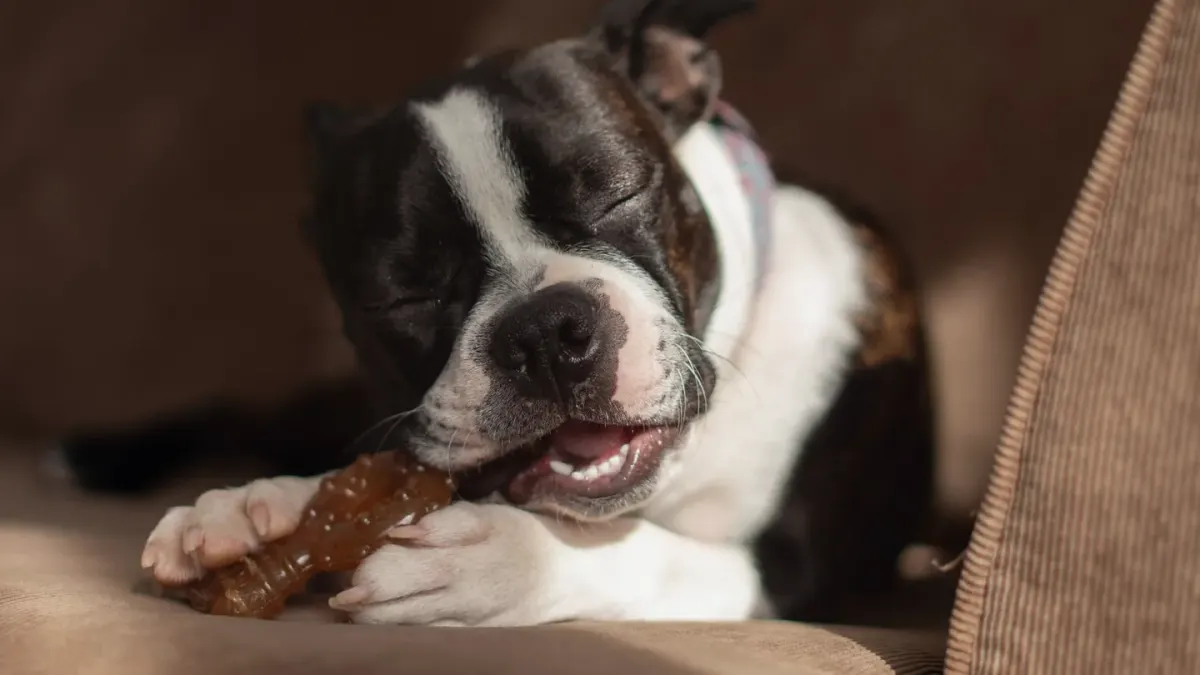
I sort chews by what happens when a piece comes off. The safest pattern for most adult dogs is give something that either flexes under the tooth, crumbles into small digestible particles, or dissolves with saliva, and take it away once it becomes small enough to swallow whole.
Practical options most dogs tolerate well include rubber puzzle toys stuffed with soaked kibble, lick mats with a thin smear of wet food, and digestible dental chews sized one step up from what the package suggests for the dog’s weight. Long-lasting nylon or hard plastic bones can work for strong chewers only if the dog gnaws rather than shears off chunks, and rawhide, bully sticks, yak cheese, antlers, hooves, and compressed bone meal treats need the same swallow-size rule. No chew is unsupervised, and no chew should be harder than the tooth trying to break it — if you cannot dent it with a thumbnail, I assume a slab fracture is possible.
That obstruction risk is the same reason I am strict about pits and other swallowed objects. The logic I laid out for whole fruit in No, Dogs Should Skip Avocado Pits for Blockage Risk applies here: a smooth object that looks passable can still wedge at the pylorus or in the small intestine. When owners ask about sharing other human foods around chew time, the onion question is a useful contrast because that risk is chemical rather than mechanical, reviewed in Can Dogs Eat Onions? What the Blood Work Actually Shows.
What to do if your dog just ate a bone
Stay calm and read the dog, not the recipe. Remove remaining fragments, check the mouth for bleeding or a wedged piece without reaching blindly down the throat, and note what was eaten and when — cooked or smoked, chicken or rib, approximate size.
Call your veterinarian or emergency clinic promptly for cooked bones, sharp fragments, vomiting, retching, drooling, abdominal pain, bloody stool, straining, lethargy, or loss of appetite. Do not induce vomiting at home unless specifically directed, and do not feed a bulky fiber fix hoping to cushion sharp edges without guidance. Bring the packaging if it was a store-bought smoked bone, and keep the dog quiet and observed for at least 48 hours even if the first stool looks normal.
My bottom line stays narrow: feed a balanced ration for nutrition, use a purpose-made chew for the urge to gnaw, and leave real bones out of the routine. The mechanism matters more than the marketing — teeth and intestine were not designed to mill brittle mineral, and the gut tends to tell us so the hard way.
Frequently asked questions
Can dogs eat chicken bones?
No. Cooked chicken bones splinter easily and can cut the mouth, lodge in the esophagus, or block the intestine. Raw poultry carries the same swallowing risk plus bacterial contamination, so use a size-matched digestible chew instead.
Are marrow bones safe for dogs?
They are a common cause of cracked teeth and jaw entrapment. If one is ever used with veterinary approval, limit it to brief supervised gnawing and remove it before the dog breaks off pieces or the opening fits around the jaw.
What chew is safest for aggressive chewers?
Choose a chew larger than the dog can swallow, flexible or digestible rather than rock-hard, and remove it once it wears small enough to fit entirely in the mouth. Rubber stuffable toys and digestible dental chews sized up are the usual starting point.