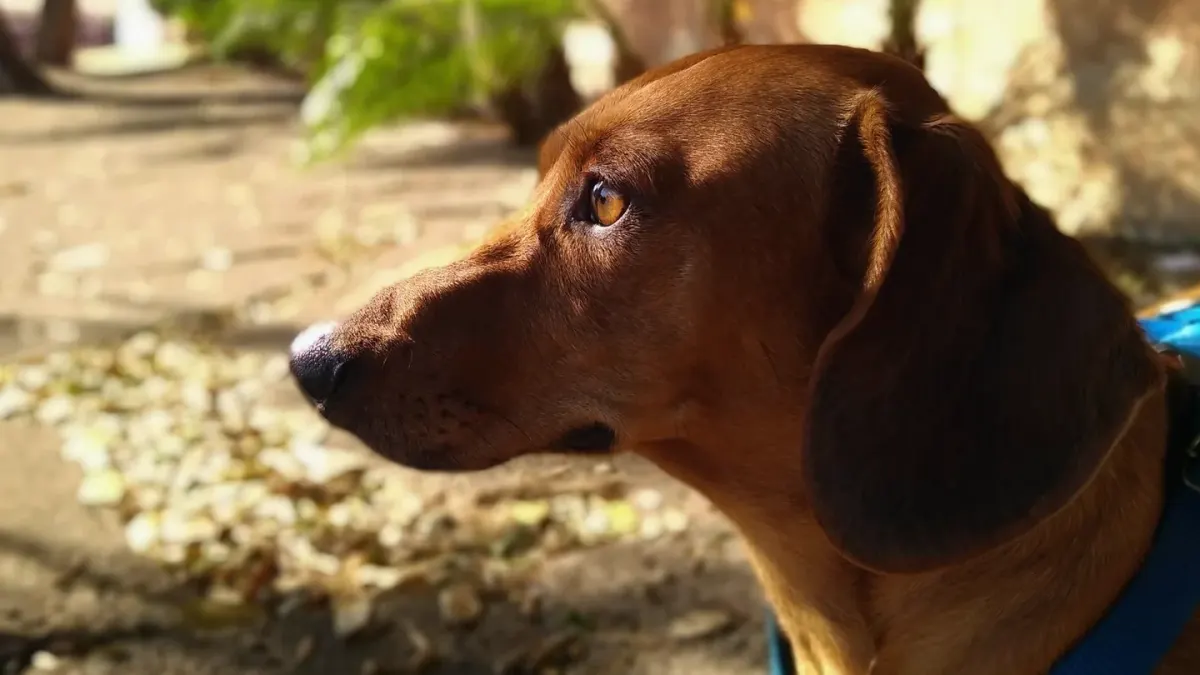
The kitchen tile is cold, the house is quiet, and your old dog needs two tries to get his hind legs under him.
That first minute tells you a lot. I read it as load, lining, and warmth — cartilage and muscle that have thinned with age, a joint lining that is slow to circulate after rest, and cold that tightens everything around it. In Chinese-medicine language this is often a Cold-Damp Bi pattern with underlying Kidney support declining: stiffness worse with cold and rest, better with gentle warmth and movement. In plain owner language: an older joint needs warm-up time.
A quick morning checklist before you change anything
- Time the warm-up: how many steps or minutes until the gait evens out?
- Note where: front legs, hind legs, back, slipping on one surface?
- Check the bed: thin mat on cold floor, draft, stairs to go out?
- Track load: yesterday’s walk length, weight trend, nail length?
- Flag reds: crying out, non-weight-bearing lameness, sudden worsening, fever or swelling with heat?
If the warm-up is under five minutes and then the dog moves fairly normally, that points more toward age-related stiffness and deconditioning. If the limp persists through the whole walk, worsens week to week, or includes swelling, loss of appetite, or night restlessness, book an exam rather than adjusting supplements.
A 12-year-old 68-pound mixed-breed dog I followed as a composite case shows how concrete this gets. He slept on a thin pad in a drafty mudroom, then had to rise on laminate to go down three porch steps for a morning toilet break. His owner timed it: 14 stiff steps before his stride lengthened, and by day 10 on a warmer bed plus a short leash walk before stairs, that number fell to six steps. Nothing about his cartilage had changed in ten days. The load, surface, and warm-up had.
Why cold and rest make an old joint feel older
Cartilage thins, muscle mass declines, and synovial fluid — the fluid that lubricates the joint — circulates less well after hours of stillness. Cold adds muscle guarding. The dog rises stiffly, short-strides, sometimes cracks or groans, then loosens once movement pumps fluid and blood through the tissues.
The literature here is modest but useful. Glucosamine and chondroitin are among the most studied joint support ingredients for dogs, and recent work describes chondroitin in terms that fit this morning picture: it “supports healthy synovial fluid homeostasis” in work published in Frontiers in Veterinary Science. That is structure/function language, not a cure claim. It means support for the normal lubrication environment, which is exactly what is sluggish after a cold night.
In vitro work is a step further from the clinic. One review notes that glucosamine HCl was shown to “prevent experimentally induced cartilage degradation in vitro” as reported in the Journal of Veterinary Medical Science. Helpful for mechanism, thin for predicting your dog’s mornings.
What joint ingredients may help support, and where I stay cautious
I still land on a short, evidence-bounded core for most stiff seniors: steady weight, daily low-impact movement, warmth and traction, plus a well-made joint supplement with glucosamine, chondroitin, and omega-3 sources such as green-lipped mussel. My position is that routine does more than ingredients, and ingredients only earn their keep inside that routine.
Green-lipped mussel is a good example of strong mechanism and thin clinical proof. Laboratory work in rodents found that “BMO, GMO, and KO all alleviated paw swelling in rats and reduced serum levels of rheumatoid factor (RF), anti-cyclic citrullinated peptide (anti-CCP) antibody, and pro-inflammatory cytokines such as TNF-α and IL-17” according to Nutrients. That is interesting biology around lipids and joint-associated markers. It is not proof that a powder will erase your dog’s cold-morning stiffness.
The strongest counterargument deserves airtime: that joint supplements are mostly expensive reassurance, and money is better spent on weight loss, pain evaluation, and physical therapy. That critique has teeth. Excess weight loads arthritic joints every single step, and no chew offsets five extra pounds.
I still include joint support because the safety profile is generally manageable under veterinary guidance, the mechanism is plausible, and morning stiffness is a long game.
An 11-year-old 52-pound retriever-type dog shows the tradeoff. Her owner started a joint chew and expected faster mornings within a week, while skipping the harder parts: she was still jumping from the SUV, nails were long, and walks happened only on weekends. Three weeks in, the morning time to loosen had not moved — still about four minutes of short hind-leg steps on cold linoleum. When we cut the jump with a ramp, trimmed nails, and moved to 15-minute daily walks, the mornings eased even before the supplement bag was finished. The failed approach was not the ingredient. It was using it as a substitute.
Reading your own dog week to week
TCVM patterns help owners sort what they see without jargon. Cold-Damp stiffness is worse on damp, cold mornings and eases with warmth. Deficiency-type stiffness — the old dog with thin hindquarter muscle, a dipped back, lagging on hills — is worse with overexertion and better with rest plus consistent conditioning. Most seniors have both.
Keep one notebook line per morning for two weeks: date, overnight low or “cold/damp,” bed location, seconds or steps to normal, and yesterday’s exercise. Bring that to your veterinarian. It separates a stable pattern from a declining one faster than memory does.
For context on aging beyond joints, many families are also watching cognition and overall senior wellness at this stage. See our guide on Signs Your Senior Dog May Have Canine Cognitive Dysfunction and the comparison of Avocado-Soy Unsaponifiables vs Glucosamine for Dog Cartilage. If you feed toppers or human vitamins alongside a senior chew, review Human Vitamin B12 Supplements vs. a Dog Senior Wellness Chew: Is Swapping Safe?.
Warmth is practical medicine here. A thick orthopedic bed away from drafts, a sweater for thin-coated dogs on cold outings, rugs over slick floors, and five minutes of gentle Tui-na style stroking and range-of-motion before stairs may help support comfort. Keep expectations realistic.
A 9-year-old 24-pound terrier mix complicates the usual arthritis story, which is why I watch edge cases. His stiffness appeared only on Monday mornings after long Sunday hikes, resolved by midday, and by day 10 of shorter daily walks instead of one big weekend walk, the Monday episode did not return. Same cold house, same age, different load pattern. Weekend-warrior soreness and early neurologic or soft-tissue issues can mimic joint stiffness. New vocalizing, knuckling, toe scuffs, incontinence changes, or a head tilt need an exam, not a warmer blanket.
Pain control itself needs a veterinarian. Never give human NSAIDs or stack joint products to force a result. Ask whether prescription pain management, weight plan, or rehab referral fits, and use supplements as background support.
Looking forward, judge the plan by the morning count, not the marketing. Shorter warm-up, steadier stairs, willingness to rise — those are wins worth keeping.
Frequently asked questions
How long should morning stiffness last in a senior dog?
A brief warm-up of a few minutes that resolves into a fairly normal walk is common with age-related stiffness. Stiffness that persists through exercise, worsens week to week, or includes crying, swelling, or inability to bear weight needs a veterinary exam.
Does cold actually worsen arthritis in dogs?
Cold does not create arthritis, but it can tighten muscles and make stiff joints feel worse after rest. Warm bedding, rugs for traction, gentle warm-up walks, and avoiding prolonged cold exposure may help support comfort.
Should I start a joint supplement for cold-morning stiffness?
Joint ingredients such as glucosamine, chondroitin, and green-lipped mussel may help support normal joint structure and lubrication, but evidence in dogs is mixed and modest. Prioritize weight, daily movement, warmth, and veterinary pain assessment first.
Sources
- Chondroitin and synovial homeostasis in veterinary research — Frontiers in Veterinary Science
- Glucosamine and experimental cartilage degradation in vitro — Journal of Veterinary Medical Science
- Marine oil fractions, paw swelling and inflammatory markers in rats — Nutrients